

Objective
Main objective
Finding ways to lift driver’s auxiliary income.
How?
One that is viewed as having high impact and has easy implementation is to increase frequency and amount of consumer tipping driver. Thus, will create an impact on overall driver’s income.
We currently, offer customer to tip after completed order, however to increase the frequency, we have to tapped on a new journey. One of them is experimenting when customer canceled order.
Problem Statement
Passenger cancellation fees are in place to ensure both customer and driver are treated fairly, and to compensate the driver for:
-
The time they’ve spent traveling to pick up you up; and
-
The loss of potential income from not accepting alternatively available bookings.
-
Improving driver availability (supply)
Why not cancellation fee?
-
When customer disputes, it will create ticket, hence it increase Operational load
-
Create burn and prone to fraud, as customer who use cash will get billed in the next order
HMW build a cancellation design that makes customer actually willing to give it to a driver as a Goodwill or token of apologies, not a penalty
Hypothesis
From customers point of view
They often in hurry and they have short patience when creating a booking, therefore a cancellation is not a great experience for them (even though it’s because of their own mistake).
How to make them empathize the driver in such condition?
Hypothesis :
-
Always mentioned that ‘driver has made an effort for you’ and ‘the tip is for the driver, not the company’
-
Tip value that is small enough for customers to spend willingly, but big enough as a good gesture, (also not big enough for the driver to abuse it)
-
Guilt trip users into giving a tip for cancelling the driver
-
Stating a fact (ex: Cancellation after driver is allocated leads to a loss of XX IDR for the driver)
From customers point of view
They need a piece of mind and appreciation, time is really valuable for them. They also will be disappointed because they lost a potential point and income. All of these reasons could ruin their mood, and their next passenger could receive a bad hospitality.
How to make the driver feel appreciated?
Hypothesis :
-
Transparency everytime a customer tipping them. They will feel that customer appreciate their effort, and thus justify to maintaining those qualities.
-
Clear communication with the customer, no one-sided cancellation
-
Tipping would foster the positive attitude and competitiveness to provide five star service
Challenges

-
Median time that user canceled is 2.6 minutes after the order created, thus in such short time customers won’t feel obliged to give a tip to driver.
-
87.68% customers always rating 5, but 74,37% of them never give any tip to the driver.
-
From 25,63% whom giving tip, more than half gave Rp2500 and another half gave Rp5000, a really small percentage give more than that. It means that the value for cancellation tip also need to be below Rp2500.
-
Excellent service is the main reason to tip, however we find that sympathetic with driver’s life struggle as the second most reason. That’s how this project try to cover, by touching customer emotion of driver’s struggle.
Methods
Usability Testing
-
Tip screen flow
-
Reason of cancellation interface
-
Tip interface
01
Concept Testing
-
Copywriting, we are going to apply GOJEK tone of voice
-
Perception; what trigger users to tip and what trigger them to not tipping
02
1. Usability Testing
1.1. Design Alternatives
To validate the proposed idea, we will conduct a usability test with guerilla methods to GOJEK customer. We tested two alternatives for both tipping and cancellation reason style (see Fig 1.1).
The scenario is similar for both alternatives (we change the order of alternative for different participant) :
-
You want to go to Lotte Shopping Avenue from Pasaraya Blok M
-
Cancel the order before or after you get the driver
-
Try canceled because your driver ask you to cancel
-
Try canceled because the driver is too far away, and you give him a tip
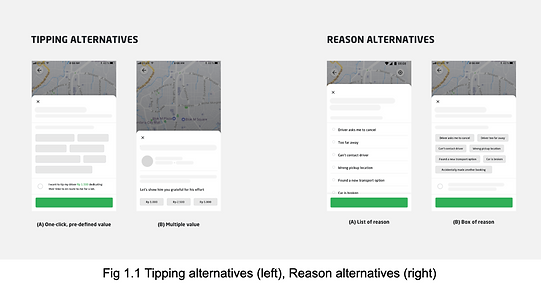
1.2. Alternative A : Pre-defined tipping and box of reason
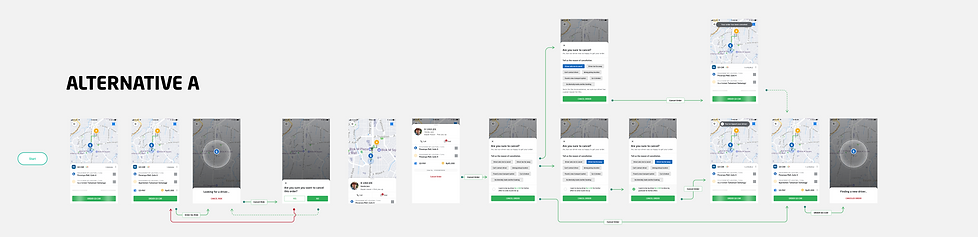
Because the customer is in hurry, adding tip option is adding more friction, therefore with this pre-defined tip design, customer only need to click one time, without extra cognitive load to choose tip value. The drawback is the tip is irrelevant if customer canceled because their driver asked them to.
At cancellation screen, we also state that the driver was so happy, and will be disappointed to lose the order → We try to make the customer keep their booking, whilst make them aware how important each booking is for the driver.
1.3. Alternative B : Multiple value tipping and list of reason

Customer were given the control to choose the tip, and the tipping screen won’t appear if driver ask customer to canceled the order.
At cancellation screen, we mentioned that the driver will arrive in X minutes, in order to persuade the customer to keep the booking.
At tipping screen, we also put the driver photo and his name along with mentioning the distance and the cost that they have burned to come to pick the user up → We want customer to realize that driver also put effort (time, energy and cost) to pick them up, however, mentioning all these variable might only work if the driver has driven long miles to pick up customer.
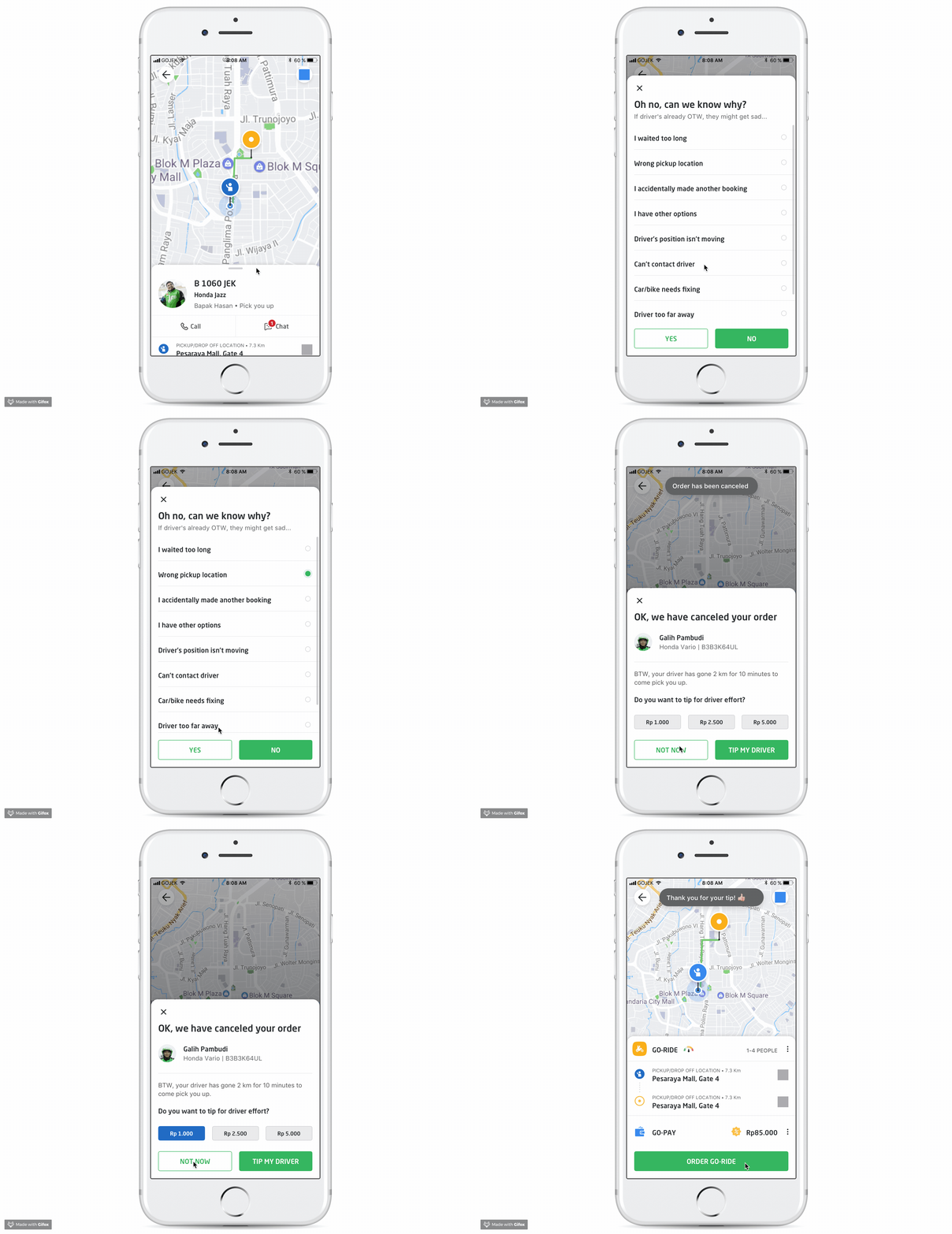
1.4. Result
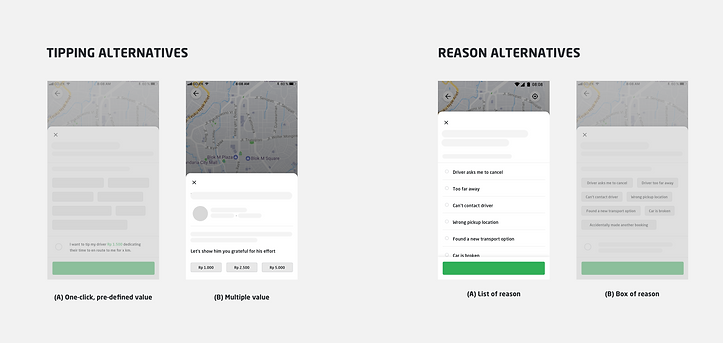
N = 5 customers
Which alternative does user preferred?



Other insights
-
4 of 5 admitted that they will give a tip if the driver make an effort to come, hence the tip is to substitute their fuel consumption cost, hence they will more likely to give a tip when the time from driver accepted to order to cancel is considerably long
-
3 of 5 commenting on "ayo tunjukkan kalau kamu berterima kasih" give a feeling that we enforce them to give a tip, and judge them as if they never give a tip before
-
2 of 5 feel that the max amount they would tip for cancellation is Rp5.000-10.000
-
4 of 5 don’t think that the driver rating will become one of the reasons they will tip.
-
2 of 5 distracted by how we are going to calculate the cost of fuel and doubt that we’re going to calculate it correctly (since there are many variables to calculate this)
Takeaway
-
The tip screen only appear if customer using GO-PAY for the trip
-
2 kind of tip screens, add another threshold : Distance >x km and Time >y mins to show driver story, otherwise the copy will mostly expressing how the driver was happy to receive the order → drive customer guilty
-
Change the driver story, to only display : Distance (km) and Time (minute)
-
Difference in tip amount for car and bike, as captured on user interview
2. Concept Testing
2.1. Research Plan
The second usability will answer :
-
Which is the best copywriting style for cancellation; casual or formal
-
What triggering them to give a tip
-
What triggering them to NOT give a tip
-
Is there any different for car and bike driver?
By understanding point 2 & 3, hopefully will reduce the potential of making cancellation tip a friction when customer wants to re-ordering
Metrics to test the copy :
-
Discoverable -- do people find it on the page?
-
Engaging -- do people choose to read it, or do they gloss over it?
-
Comprehensible -- do people understand what it says?
-
Readable -- do people find it easy to read, or is it effort?
-
Agreeable -- do people find it pleasant, neutral, or even offensive?
-
Comprehensive -- does it cover all the topics you need?
-
Effective -- does reading the copy change the way the user acts in the desired way?
Each of these have different goals, but they all have similar methods: present the content in situ, and ask the user about their task. If they do discover the text and read it, ask them about what they read to query understanding. If they don't, it's probably not discoverable enough; noting that, direct them to it and ask them what they think. And so forth--similar methods to the rest of usability testing.
2.2. Result
Threshold
We realize that one of the challenges is that adding one step on cancellation event will potentially become a friction, and potentially inflict user anger. Therefore we have to clearly distinguish at what time this screen consider appropriate to appear.
How we distinguished it? At this research we try to find out :
-
The trigger that made user willing to give tip
-
The condition that made user most unlikely to tip
The trigger
Our hypothesis is that The willingness to tip depend on the time between driver dispatch to cancel. We prepared 2 scenarios where driver ETA >15 mins; the first one, user and driver has agreement from both side to pick up, then user canceled the trip voluntary, and the second one, user is in hurry. From this scenario, the findings are :
— At second scenario, 5 of 6 are not choosing tip, 2 of them canceled right away without contacting driver
— At first scenario, 6 of 6 are choosing tip, 3 of 6 chose 2500, and the rest chose 5000.

From this findings, we could conclude that we will not display the Cancellation Tipping screen if customer choose these cancellation reason (view image below for detail) :
-
Driver asked me to cancel
-
Can’t contact driver
-
The vehicle is broken
-
Driver position not moving
And we will display the Cancellation Tip if customer choose :
-
Wrong pick up address
-
I have other option
-
I accidentally made another booking
-
Driver too far away
-
I waited too long
-
Not choosing any reasons


3. Wireflow
